Why Forex and Gold Still Make Sense to Me, With All Their Problems?
The real question isn't which instrument has the most opportunity, it's which one survives contact with a working adult's calendar. Why a full time job, few instruments, and repeated conditions matter more than chasing whatever's moving this week.
⏱ 5 min read
Let me start with what these two actually cost you, because that part usually gets skipped. The forex market never closes during the week, so there is no bell at 5pm telling you that you are done for the day, which means the only thing stopping you from trading at 2am is you, and you are not reliable at 2am. Leverage is handed to you like free chili sauce, so one careless hour can undo a month of decent work. Your broker sits on the other side of your fill. And if you go the funded route, you are trading inside someone else’s rulebook, where an account can be closed for reasons that have nothing to do with whether your trades were good. I have had that happen. So no, this is not the easy corner of the market.
Then why not just buy stocks, or crypto, or whatever is trending. There are thousands of instruments out there and most of them are more forgiving than a 1:100 gold position.
Because the real question is not which instrument has the most opportunity, it is which instrument fits the life you already have. I work full time in engineering firm. My week is site surveys, licensing submissions, drawings coming back from the design side, pricing that needs to be signed off before Friday. I am not quitting that to stare at charts, and I would not advise anyone to. So whatever I trade has to survive contact with a working adult’s calendar.
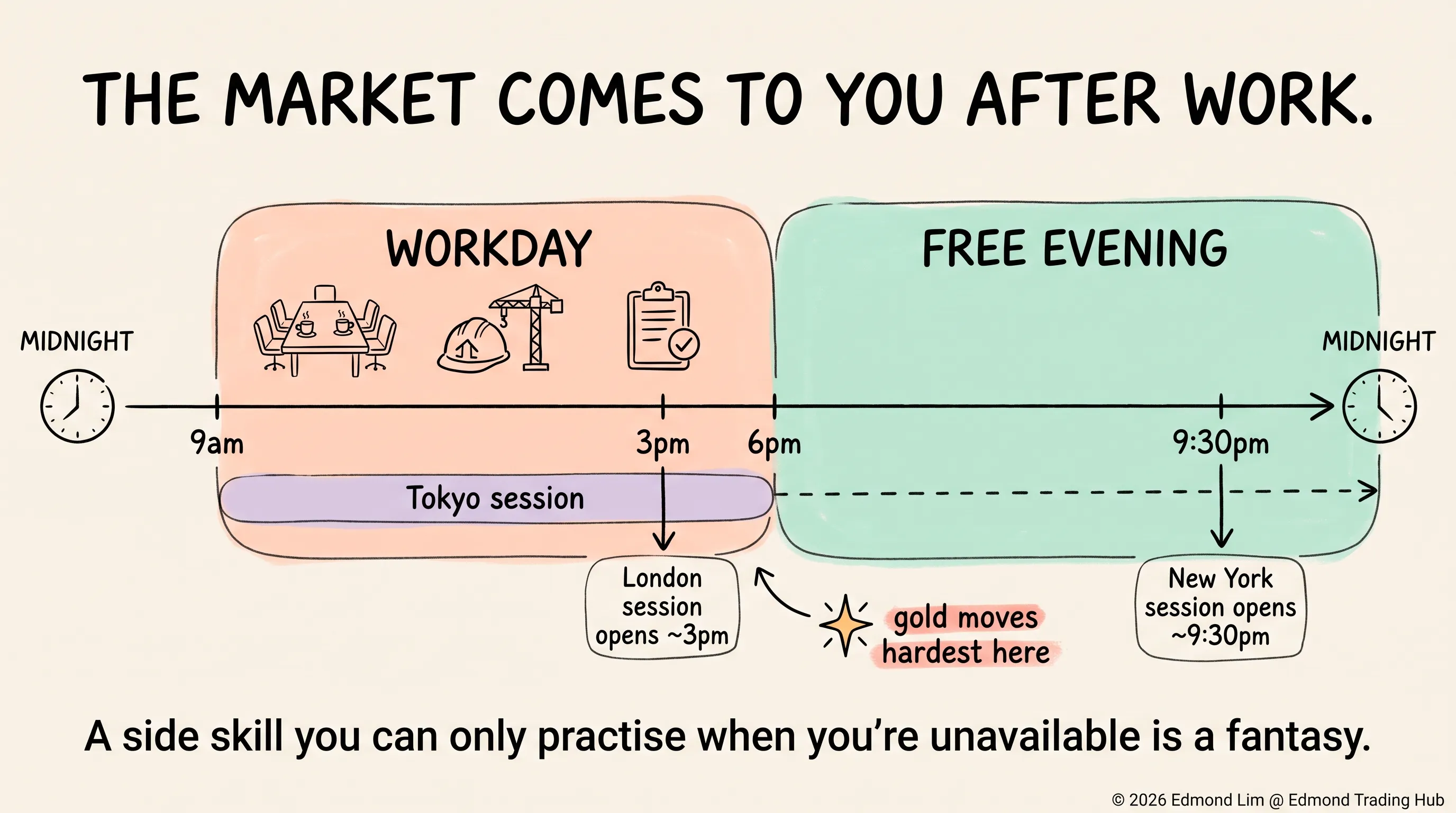
That is where forex and gold quietly win. The local stock exchange opens at 9am, which is when I am usually in a meeting or halfway up a site roof. But London opens around 3pm my time and New York around 9.30pm, and gold moves hardest in exactly those windows. The market comes to me after work instead of asking me to be free during it. That is not a small technical detail, it is the whole thing. A side skill you can only practise when you are unavailable is not a side skill, it is a fantasy.
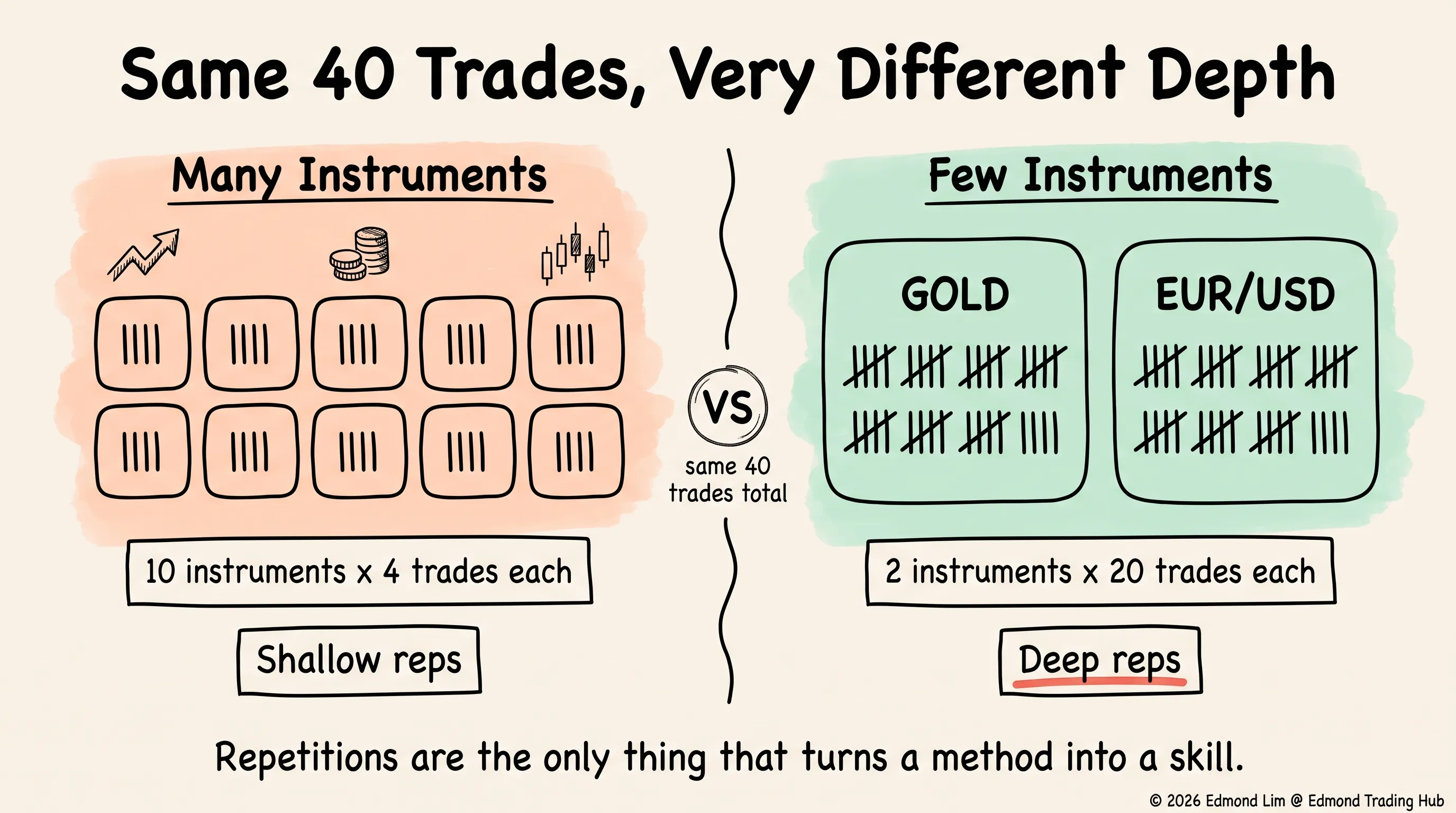
The second reason is that there are so few of them. Majors plus gold is maybe eight instruments worth watching, and honestly you only need two. Compare that to picking through a few thousand listed companies. Think about the noodle stall uncle who has been at the same corner for thirty years cooking one dish. He is not better than you because he found a secret recipe, he is better because he has cooked that plate forty thousand times and he knows exactly what the wok sounds like when it is ready. The restaurant with two hundred items on the menu is mediocre at all of them. In engineering it is the same, I am not designing a brand new module for every project, I use the same panels and the same inverters over and over, and what actually improves is my reading of the site. Narrow instrument list, repeated conditions, that is where a skill compounds.
Gold gets its own mention because it is unusually clean to read. There is no CEO who can get arrested overnight, no earnings surprise at 5am, no delisting, no auditor finding a hole in the accounts. It is a lump of metal, and the things that move it are few and stable, the dollar, real interest rates, and how scared everyone is this month. Fewer moving parts means your analysis can actually be tested. It also cannot go to zero, which sounds obvious until you remember that a company is a promise and a promise can default.
And then position sizing. You can trade 0.01 lot. You can learn on amounts that will not hurt you, then scale the exact same process up later without changing anything about how you trade. That is like learning to cook by buying rice by the kilo instead of committing to a whole sack, the recipe does not change when the pot gets bigger. Very few markets let a beginner practise at that resolution.
The challenges I opened with are real, I am not talking them away. But notice that almost all of them are operator problems, not instrument problems. Twenty four hour access does not force you to trade at 2am. Leverage does not force you to use all of it. The instrument is neutral, the rules you bring to it are not, and that is genuinely the entire difference between the people who last and the people who reload.
I used to think more instruments meant more chances, that if forex was slow this week I should go find something moving in crypto or indices. That is a wrong mindset. Spreading yourself across markets does not multiply your opportunities, it divides your repetitions, and repetitions are the only thing that turns a method into a skill. Fewer instruments, more reps, in a session your actual life can support.
So if you are starting: pick two instruments, gold and one major pair is plenty. Pick one session that fits your job, London if you finish by 5, New York if you are a night person. Then log fifty trades on that exact combination before you allow yourself to look at anything else. If your edge is real it will show up in fifty. If you cannot sit still for fifty, the instrument was never the problem.
Free Weekly Market Outlook
Gold analysis, forex outlook and trading ideas — every Sunday.
Subscribe Free