Mountain of Strategies Out There, Which One to Choose?
Two years lost switching strategies every few weeks taught me the mountain of SMC, SNR, SND, price action, candlesticks, and volume profile is really just four questions wearing different names. How to sort the pile, and why adding to your method beats switching it every time.
⏱ 7 min read
I spent close to two years answering this question the wrong way, and the cost was not money, it was sample size.
Every few weeks I found something better. SMC because the order block explanation looked so clean on a replay, then plain SNR because SMC felt overengineered, then candlestick patterns because I wanted a rule I could see on one bar, then EMA crossovers because I wanted a rule that did not need my judgement at all, then SND because zones felt more honest than lines, then back to raw price action because I decided I had been overcomplicating everything. Each one got a handful of trades, hit a losing patch, and by then the next thing had my attention. On paper I was comparing options and doing my research. In practice I was starting from zero over and over, and after 24 months I had nothing to show for it except a folder of screenshots and opinions.
The thing that finally got me out of the loop was not picking the right one. It was sorting the pile.
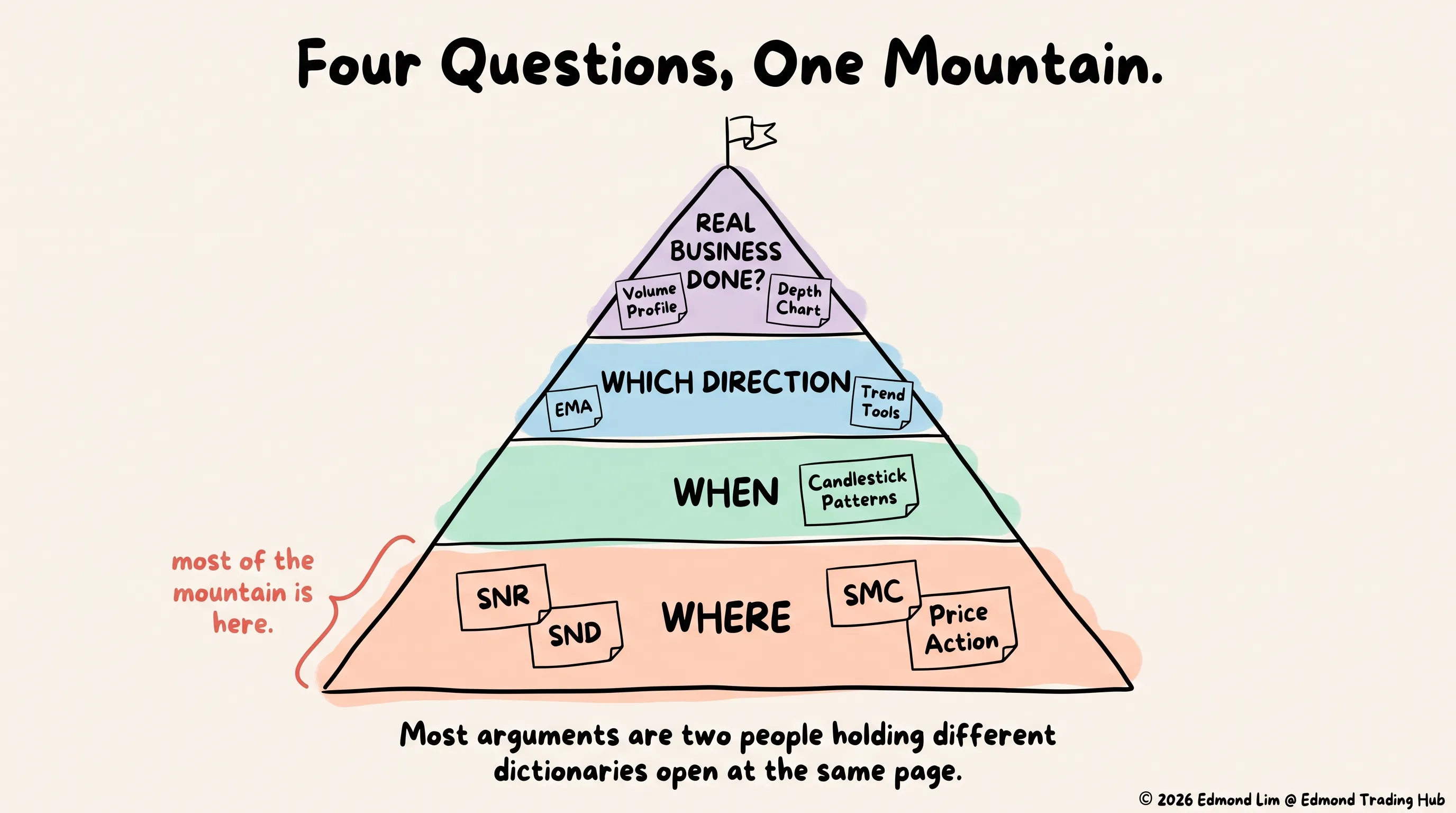
Look at what each of those actually answers. SNR, SND, SMC and most of what people call price action are all answering the same question, which is where. A support level, a demand zone, a bullish order block, they are pointing at the same spot on the chart, a place where price previously ran out of sellers and turned. I speak three languages, and water is water in all of them, the word changes and the thing does not. SMC just adds narrative on top, a story about who was buying and why, but you are marking the same candle you would have marked with SNR.
Candlestick patterns are not answering where. They are answering when, as in price is at your level now, do you pull the trigger on this bar or wait. Different question entirely. EMA and trend tools answer which direction you should even be looking. And the depth chart and volume profile answer something none of the others can, which is whether there was actual business done at that level or whether price just wicked through it in a hurry and left.
Four questions. One mountain. And when you sort them out you see that most of the mountain is piled into the first question, four or five names for the same idea, while entire questions sit almost empty. Which means most arguments about which strategy is better are two people holding different dictionaries open at the same page.
Once I saw that, choosing stopped feeling like a gamble. I come at this from over ten years in engineering, and we never select equipment by asking which brand is best. We ask what the duty point is, what the site conditions are, what the budget allows, and most importantly who is going to maintain the thing after we hand it over. A beautiful piece of kit that nobody on site can service is a bad specification, even if it is technically superior. Same here. The best strategy on paper, run by someone whose life does not fit it, is a bad specification.
I hold a full time job. I cannot sit at a screen at 3pm on a Tuesday, so anything needing intraday babysitting is out, no matter how good the numbers look. Anything that needs me to be emotionally neutral right after a bad day at work is out too, because I know I am not. That sounds like lowering the bar. It is the opposite, I am removing the strategies I would abandon in month two anyway, and abandoning is the only failure that has ever actually cost me anything.
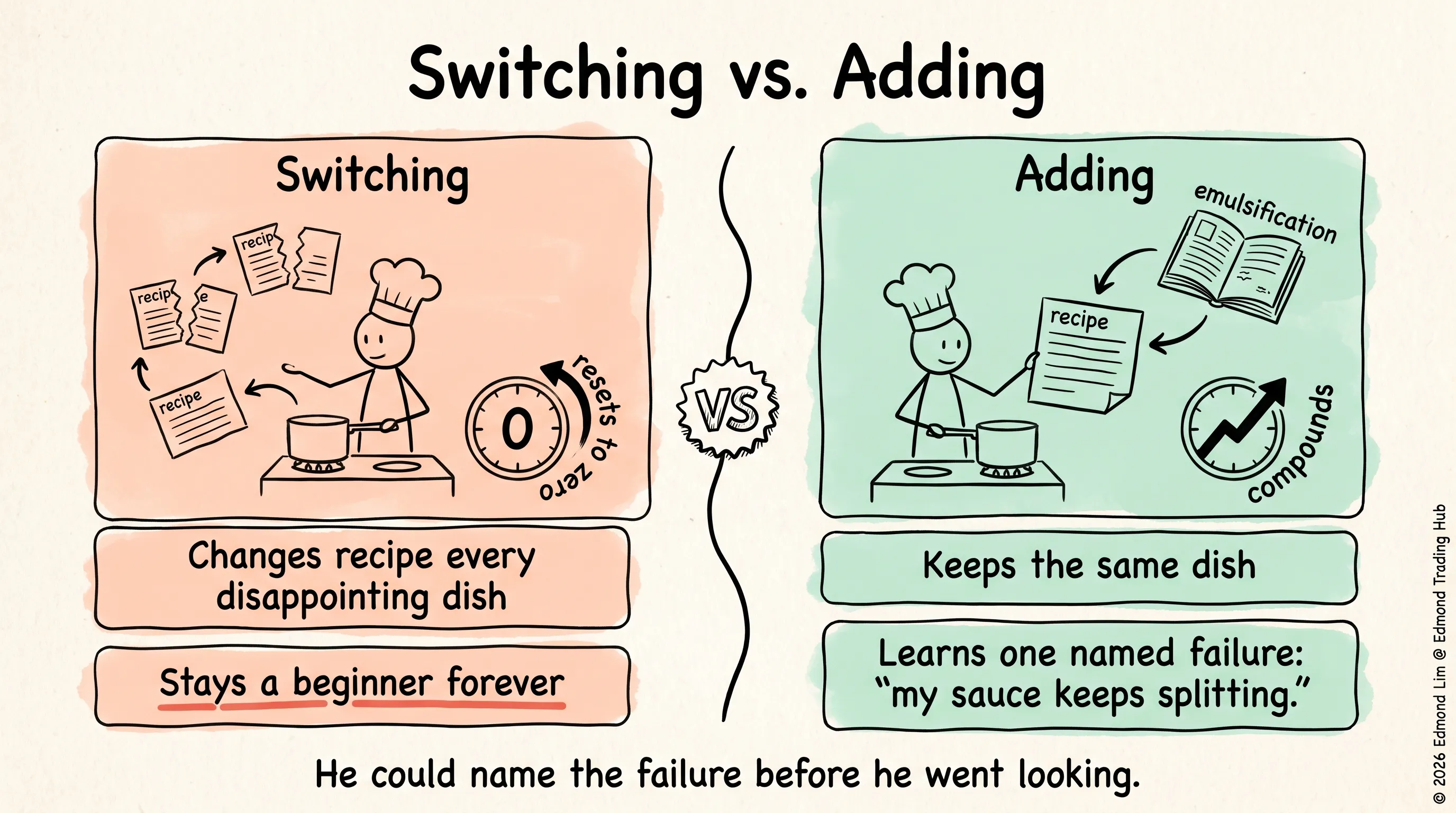
Because here is what switching does. Think about how a doctor builds judgement. They do not read every diagnostic framework and pick the most elegant one, they run the same examination sequence a few thousand times until the abnormal jumps out before they can explain why. That only compounds if the sequence stays the same. Change your method every three patients and you stay a beginner forever, no matter how many patients come through the door. Every switch resets your experience count to zero while your calendar keeps running.
Which brings me to the honest part, because I have just moved to volume profile analysis marking out previous session POC,VAH and VAL, and by my own argument that should make me a hypocrite.
It is not the same move, and the difference is the whole point of this article. I did not throw out how I mark levels. I kept every bit of that and added something on top of it, because I had a specific problem I could name in one sentence: too many of my losers were good looking levels that price ran straight through without hesitating. Marking the level was never my failure. Knowing whether anyone had actually done business there was, and no amount of relabelling my zones as order blocks was going to answer it. Volume profile answers exactly that question, so I went and learned it.
That is switching versus adding. A cook who changes recipe every time a dish disappoints never gets better at cooking. A cook who keeps making the same dish and goes to learn emulsification because his sauce keeps splitting is doing something completely different, and the difference is not effort or curiosity, it is that he could name the failure before he went looking.
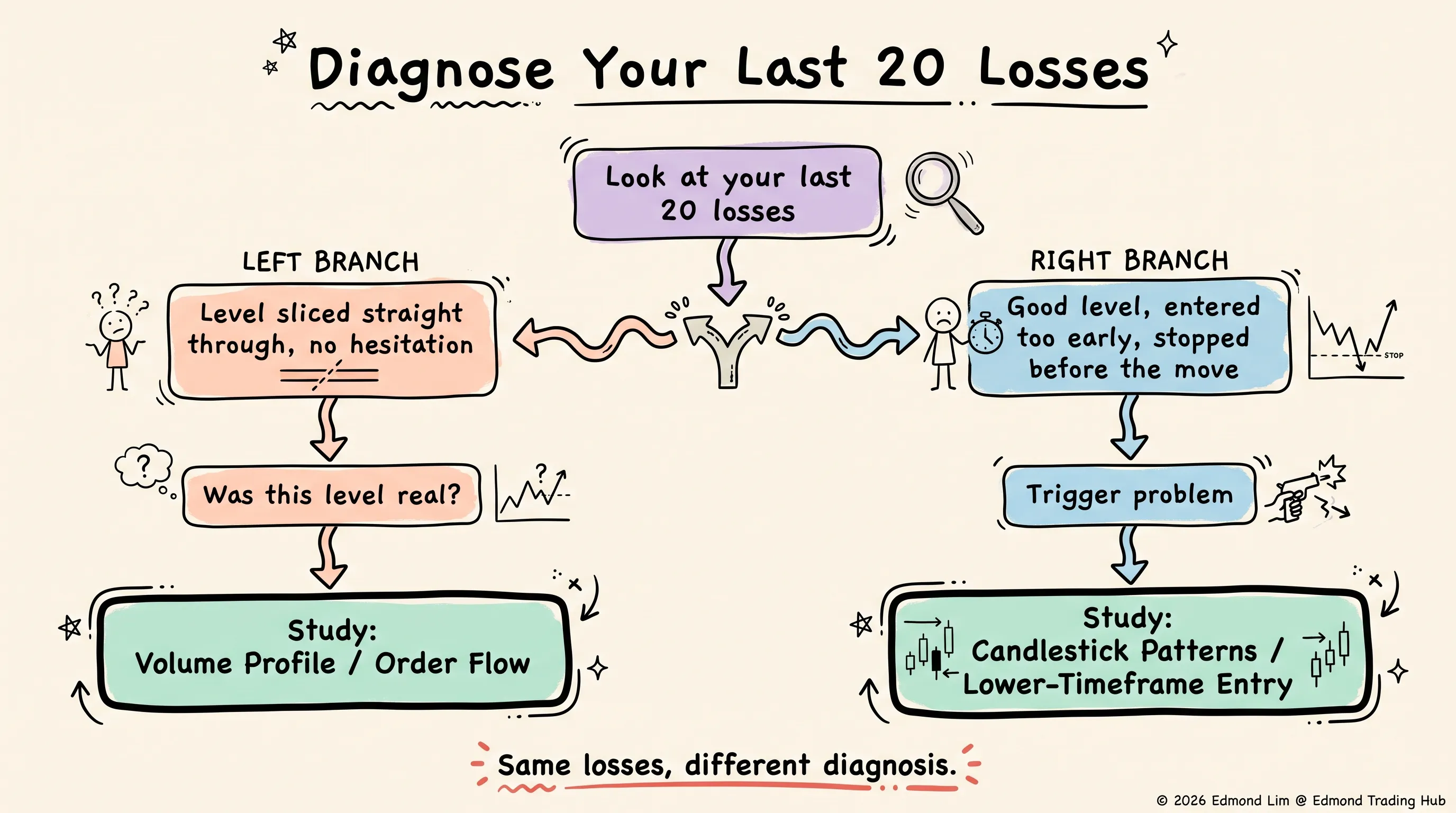
So should you learn more. Yes, but only when you can finish this sentence: my losses keep happening because I do not know ______. If you cannot fill that blank in one line, you are not learning, you are shopping, and shopping feels productive in exactly the same way that reorganising your desk feels like work.
The good news is that your own trades will tell you the answer if you write them down. If most of your losers are levels that price sliced through, that is a “was this level real” problem, go study volume profile or order flow. If most of your losers are good levels you entered too early and got stopped before the move, that is a trigger problem, go study candlestick patterns or a lower timeframe entry. Same losses, different diagnosis, and the diagnosis is what tells you which part of the mountain to walk up.
I used to think the mountain existed because nobody had solved the problem yet and somewhere in it was the right answer I had not found. That is wrong. Most of it is one answer translated into five vocabularies, sold five times by five different people, and the handful of tools that genuinely answer different questions are useless to you until you have your own losses to point them at. Learning more was never the problem. Learning more without a named question is.
So do this today. Sort whatever you already know into those four questions and notice how lopsided the pile is. Pick one name for where and stop reading about the other four. Then go through your last twenty losses, write the one sentence, and only go learning after you can say it out loud.
Free Weekly Market Outlook
Gold analysis, forex outlook and trading ideas — every Sunday.
Subscribe Free