What Is Forex Anyway, And Why Is A Forex Broker Not The Same As A Stock Broker?
There is no central exchange for currencies, which means your forex broker isn't sending your order anywhere, you're trading against them directly. Why that changes your price feed, your volume data, your leverage, and what to actually check before you deposit.
⏱ 6 min read
The expensive thing about forex is not the leverage or the volatility. It’s that most people trade it for years without ever understanding who is on the other side of their order, and by the time they find out, they’ve already paid tuition for the lesson.
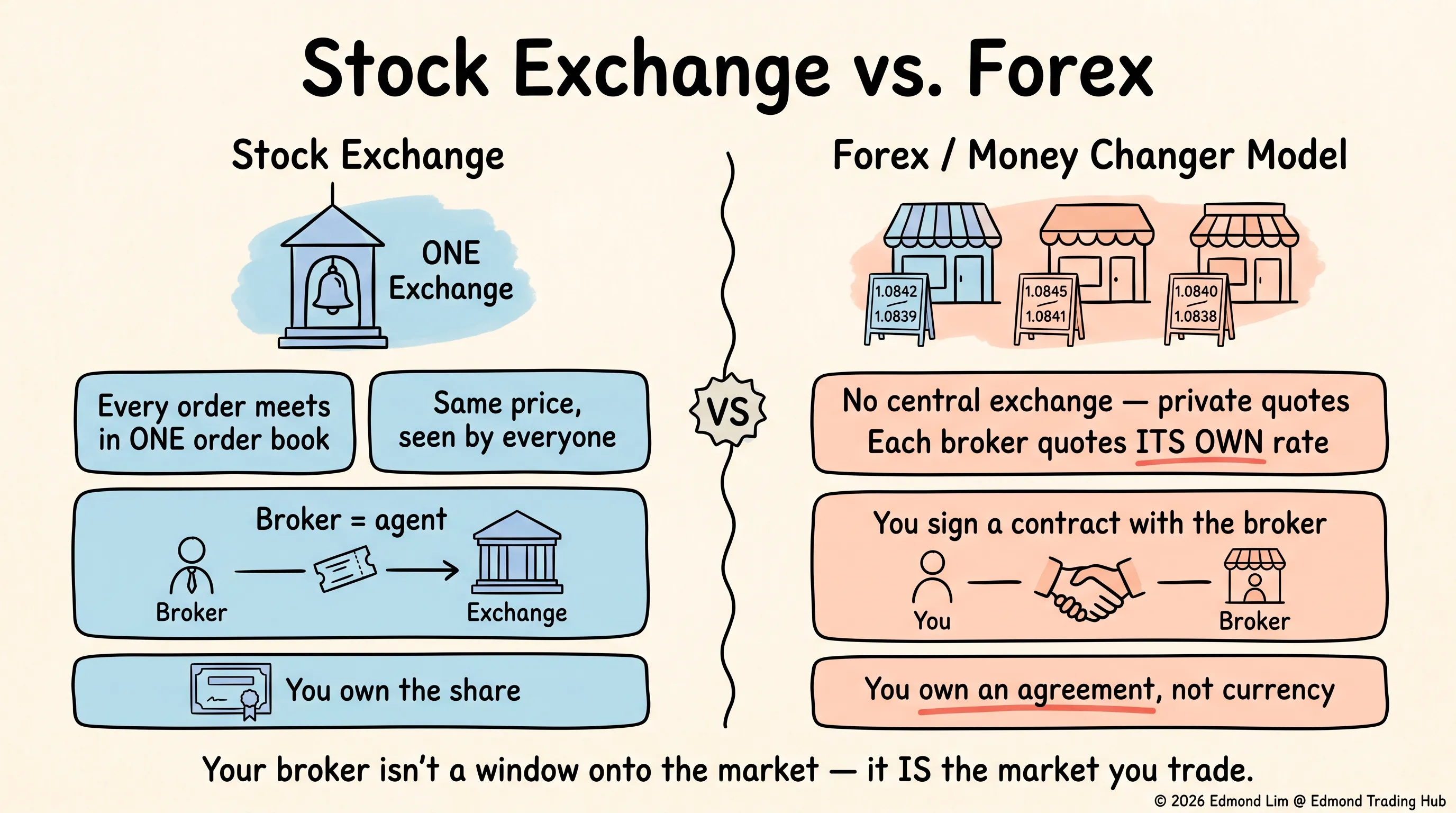
Start with something almost everyone has done. You go to a money changer before a trip to Bangkok. The shop has two numbers on the board, one price if you’re buying baht and a slightly worse one if you’re selling it back. Walk 50 metres down and the next shop has different numbers. There is no central board that all money changers must obey. Each shop quotes its own rate, each shop is the one you’re transacting with, and the gap between their buy and sell price is how they eat.
That is forex. The whole global currency market is that, scaled up to about seven trillion US dollars a day, done between banks, funds, corporates and brokers over private connections instead of on a public floor. There is no NYSE for currencies, no single centralised exchange for the euro. Nobody rings a bell. It’s decentralised, which sounds sophisticated but really just means the money changer model all the way up.
Now compare that to buying shares in a listed company. There’s exactly one exchange it trades on. Every buyer and seller meets in the same order book, the price you see is the price everyone sees, and your broker is basically an agent. They take your order, send it to the exchange, take a commission, and at the end you own something. A share sits in your account with your name attached to it, and it exists whether your broker is around next year or not.
Your forex broker is not doing that job. Nothing is being sent to an exchange, because there isn’t one. When you click buy on EURUSD, you’re entering a contract with the broker. You don’t own euros. You own an agreement with a company about what happens to a number. That distinction sounds academic until the company is the problem.
Which leads to the part nobody puts in the marketing. Many retail forex brokers are the counterparty to your trade. Internally the industry splits this into what they call A book and B book. A book means they pass your order out to a bigger liquidity provider and earn from the spread and commission, so they’re basically the ticketing agent. B book means they keep your trade in house and take the other side themselves, so your loss is directly their revenue. Most brokers do a mix, and they decide which bucket you go into based on how you trade. Think of an insurance company. They’ll happily carry your risk while you’re a safe bet, and reinsure you out the moment you look expensive.
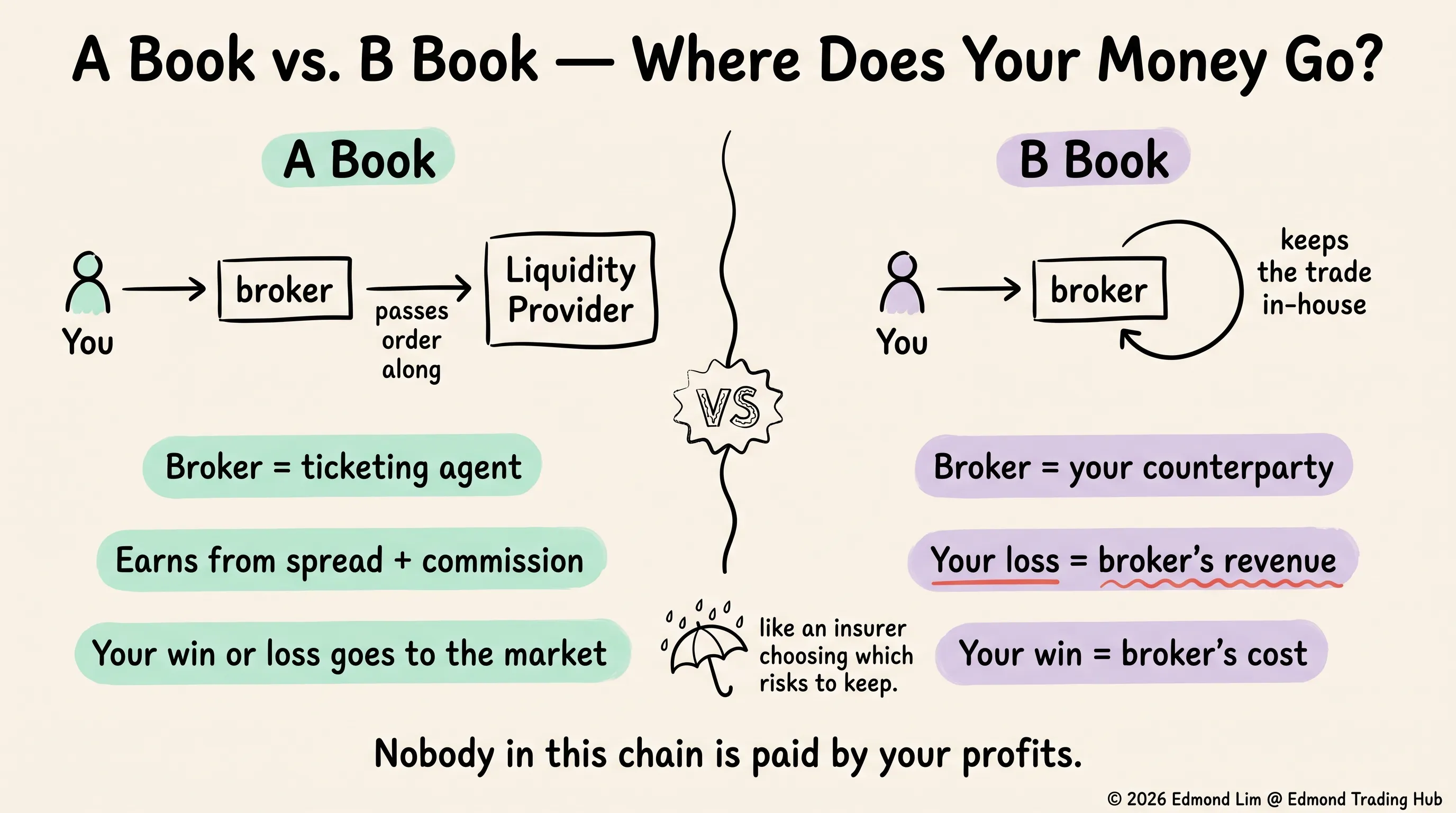
I got interested in this while looking into introducing broker rebate structures, where you get paid a slice of the spread on every lot traded. Once you see where that money comes from, the picture becomes clear fast. It comes out of the cost of your own trade. Nobody in that chain is paid by your profits.
Two more things follow from having no central exchange, and both matter more than people expect.
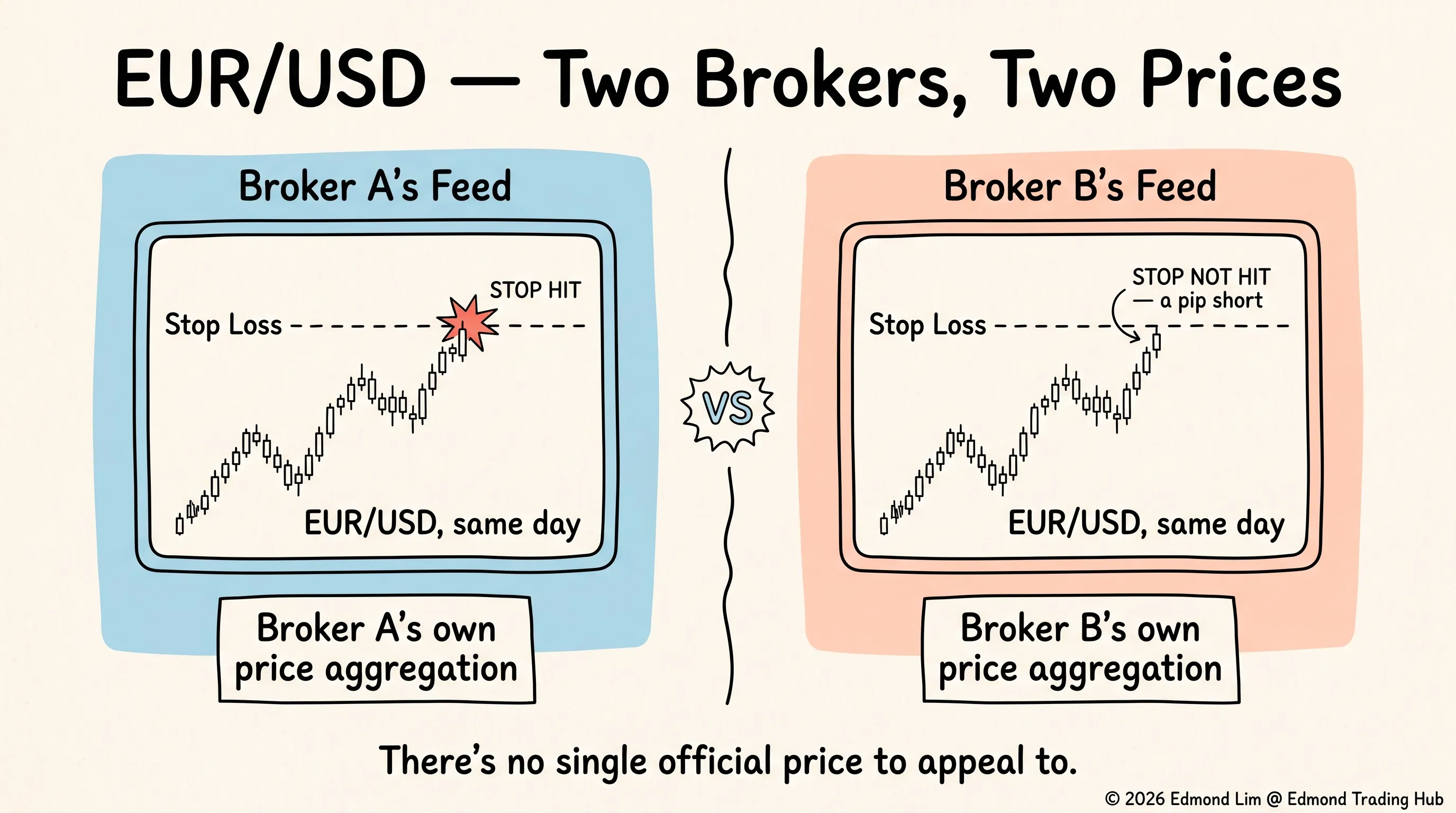
First, the chart is not universal. Your broker’s price feed is their own aggregation, so the exact high of the day can differ between two brokers by a pip or two. Your stop can get hit on one platform and not another. Nobody is cheating you, there simply is no single official price to appeal to.
Second, there is no real volume data. On a regulated exchange like CME you can see how many contracts actually traded, because everything cleared through one venue. In spot FX, what your platform labels as volume is tick count, meaning how many times the price updated, not how much money changed hands. I use volume profile as a mandatory filter in my own process, so this one bothered me for a long time until I accepted the workaround, which is to read volume from currency futures on CME where it’s real, and apply that reading to the spot pair.
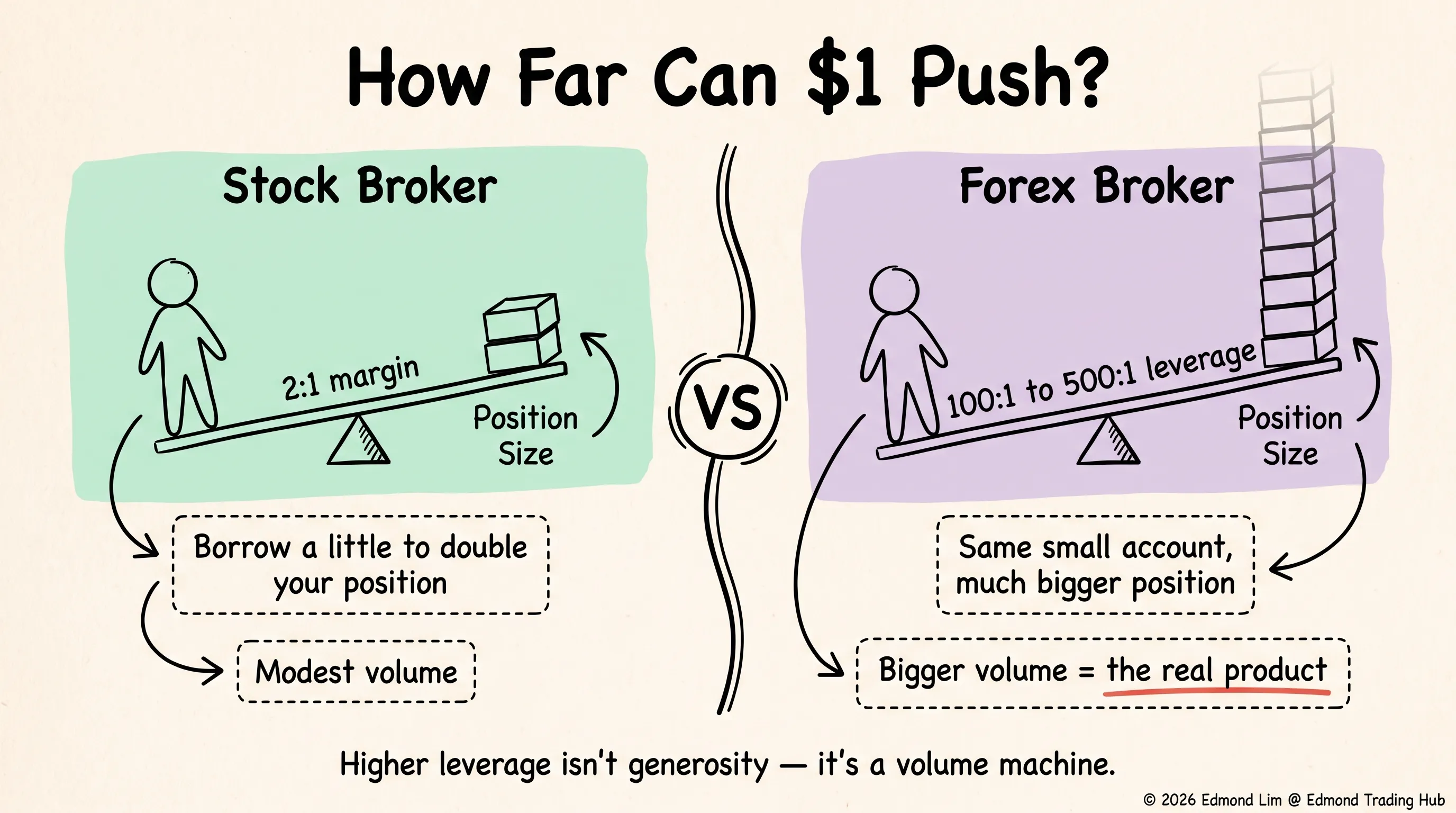
Then there’s leverage, which is the part that gets all the attention. A stockbroker might let you borrow enough to double your position. A forex broker will happily give you 100 to 1 or 500 to 1. That isn’t generosity. Higher leverage means smaller accounts generate bigger volume, and volume is the product being sold.
And regulation, which for us is the awkward bit. Most retail forex brokers are not licensed by your home country’s central bank or securities regulator, because that oversight was built for banks and capital markets, not spot currency speculation. That leaves the whole activity sitting in a grey area rather than a clearly settled one in a lot of places. Regulators that do track unlicensed operators usually publish some kind of alert list, and it is worth checking a broker against it. Worth reading the current rules for wherever you actually live rather than taking anyone’s word for it, mine included, because it’s your money and your exposure, not theirs.
I used to think picking a broker was a shopping exercise, tightest spread, best platform, whatever bonus they were dangling. That is a wrong mindset, and it’s the one that leaves people stuck when something goes wrong. I’ve had an account frozen elsewhere in this industry, and the only question that mattered in that moment was who I could escalate to. The answer was nobody with teeth.
So before you deposit anything, do three checks. Look up the regulator and the licence number, then check which legal entity actually appears on the deposit page, because groups often hold a respectable licence in London and route you to a shell in a small island jurisdiction. Ask them directly in writing whether your account is A book or B book and keep the reply. And open the same pair on two different brokers, put the charts side by side, and watch the prices disagree. Once you’ve seen that with your own eyes, you’ll stop thinking of the market as one thing and your broker as a window onto it. Your broker is the market you actually trade.
Free Weekly Market Outlook
Gold analysis, forex outlook and trading ideas — every Sunday.
Subscribe Free