Who's Actually Paying You? A Test for Every Income Stream Around Trading
Rebates, copytrading, prop firms, education, tools, AI bots, almost nothing in this space pays you when the trader wins. A two question test for figuring out which side of that line you're standing on before you build an income around it.
⏱ 7 min read
The uncomfortable thing about this corner of the market is that almost nobody in it makes their money the way you assume. Brokers don’t make money predicting price. Prop firms mostly don’t make money trading. A lot of educators don’t make money trading either. They make money from traders. Once that lands, “what else can I do here besides trade” stops being a menu of side hustles and turns into a question about which side of the table you’re willing to sit on.
I came at this from engineering, over ten years of it, and my day job is still handling engineering projects, where an undersized cable is a fire and not a bad quarter. That leaves you with one habit worth keeping, which is asking who pays for something before asking how much it pays. On a daily basis I can trace every dollar, a site buys energy it was going to buy anyway, and everyone downstream takes a slice of a real transaction. In retail trading the trail is muddier, and if you don’t follow it you can end up with a very comfortable income that quietly runs on other people losing.
So here’s the test, and honestly this is the whole piece. For anything you get offered in this space, ask two questions. If this goes well, who is actually paying me. And do they know they’re paying.
Rebates first, because it’s the one most people fall into by accident. You refer someone to a broker, you get paid per lot they trade. Not per lot they profit on, per lot they trade. That is a mechanic paid by the number of parts he swaps out rather than by whether your car runs, and you already know what that mechanic tends to recommend. There is an honest version of it, where you disclose the arrangement out loud, you keep your content untied to volume, and you’d send the same person to the same broker with zero payout attached. Most people don’t run it that way, and you can spot them easily, because their content is always about entries and never about sitting out.
Signals and copy trading fail the same test harder. You get paid whether the follower wins or loses, and you never eat the drawdown. It’s a navigation app charging you per turn instead of per time you actually arrive. The moment you cross from publishing an opinion into directing or managing someone else’s money for a fee, you’re in licensed fund management territory in most jurisdictions, and you need a licence for it, so the grey area is a lot narrower than the Telegram groups make it look.
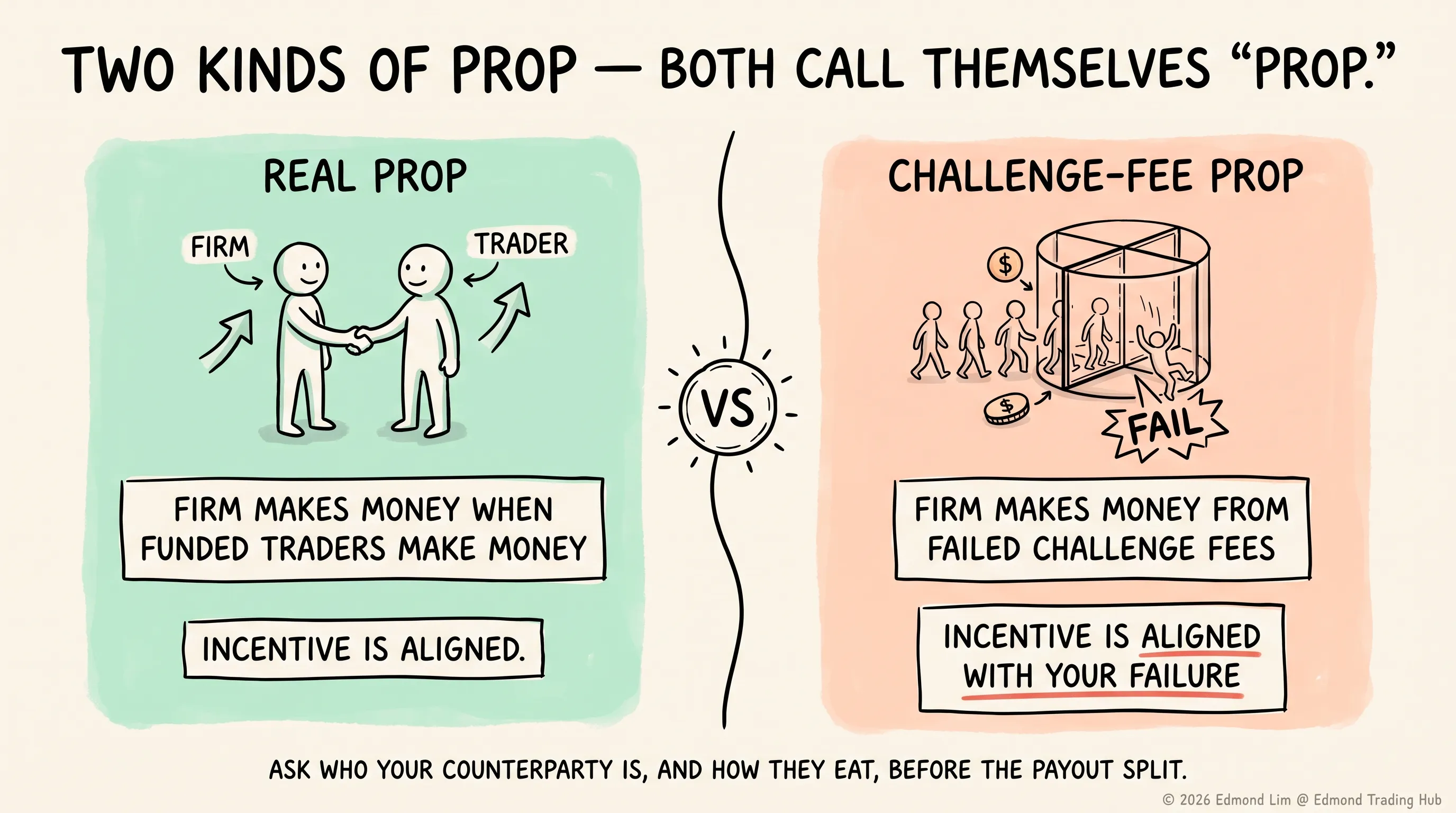
Prop firms are worth splitting in two. There is the model where the firm makes money when funded traders make money, and there is the model where the firm makes money from failed challenge fees. Both call themselves prop. I learned to care about that difference the expensive way, having an account killed over a device ID match with no meaningful appeal, and the lesson wasn’t really about the fee, it was that I had handed over months of my time without once asking who my counterparty was and how they ate. Ask that first, before the payout split.
Education can be clean, but only under two conditions. You teach process instead of outcomes, and you’re honest about the base rate. A driving instructor doesn’t promise you’ll never crash, he promises you’ll know what to do at a junction. The second condition is that you can only teach what you’ve personally survived, which for most people means waiting a lot longer than they’d like before charging anyone.
Then there’s the part I’ve drifted into, which is tools. Journals, calculators, data cleaners, indicators, anything that takes friction out of work a trader already has to do anyway. I built a pre-trade stop and target visualiser for MT4 because I was tired of eyeballing risk in my head, and a cleaner that turns messy broker exports into one usable journal, and a stack of calculators for the same reason I’d build a spreadsheet at work. What I like about this category is that it passes the test without any argument at all. You sell a good knife to a cook, the knife is worth the money whether his restaurant is packed or dead, and you are never quietly hoping he has a bad night.
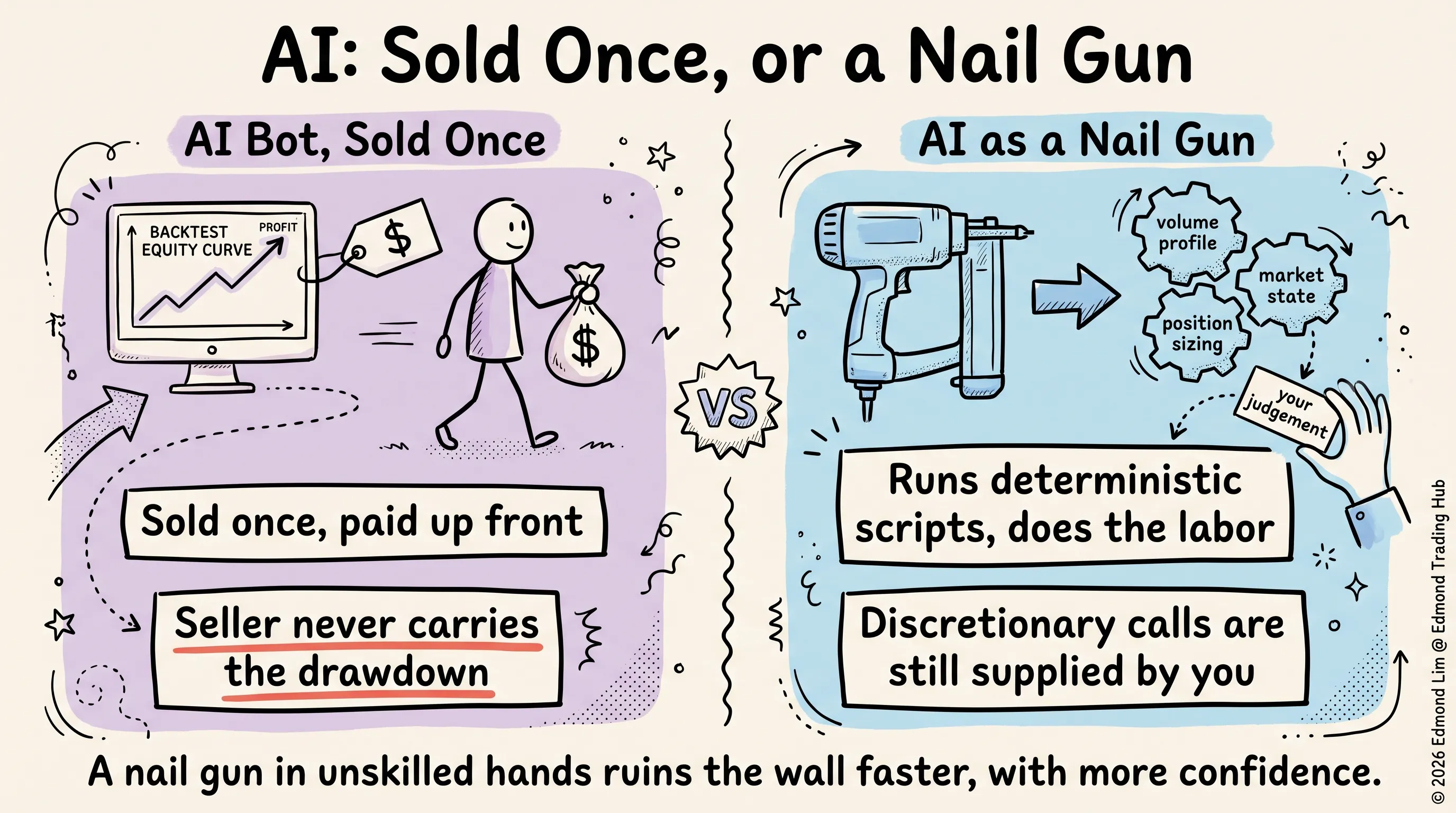
AI deserves its own paragraph, because it’s the one thing that lands on both sides of the line at once. The version flooding your feed is a bot with a backtest curve, an AI signal group, a model that supposedly reads the next candle. Sold once, paid up front, and the seller never carries the drawdown, so it fails the test for exactly the same reason signals do. It’s just better dressed now, because a language model can produce an equity curve, a testimonial and a landing page in one afternoon. The cost of looking credible has collapsed. The cost of actually being right hasn’t moved at all.
The other version is quieter, and it’s the one I actually run. My broker data is wired into an AI assistant, but the model isn’t allowed to look at a chart and tell me what it sees. It runs deterministic scripts I wrote, volume profile, market state, position sizing, and anything discretionary that it can’t know is supplied by me instead of guessed. What it does is the part that was always just labour, cleaning exports, reconciling deals, drafting notes, checking my own rules against my own journal. That’s a nail gun, not a carpenter. Hand a nail gun to someone who can’t frame a wall and he’ll ruin it faster and with more confidence, which is roughly what happens when you automate a process you never tested by hand.
Writing sits next to all of this, slower and much less obvious. Notes, research, a knowledge site nobody reads for the first year. It pays in reputation rather than cash, and reputation is the thing that eventually opens the licensed doors, analyst work, risk, treasury, a real seat where you’re allowed to touch other people’s money because someone checked that you should be.
I used to think the question was how else to extract money out of the market, as if the market were an employer with more than one job opening. That’s the wrong frame. The market doesn’t employ anybody, it pays you nothing for showing up, and every dollar you pull out of a directional trade came out of somebody else’s account. The money around it that lasts is made by serving traders in ways that don’t need them to lose. Every few years a new technology shows up and gets sold here as a shortcut, and the test doesn’t change at all.
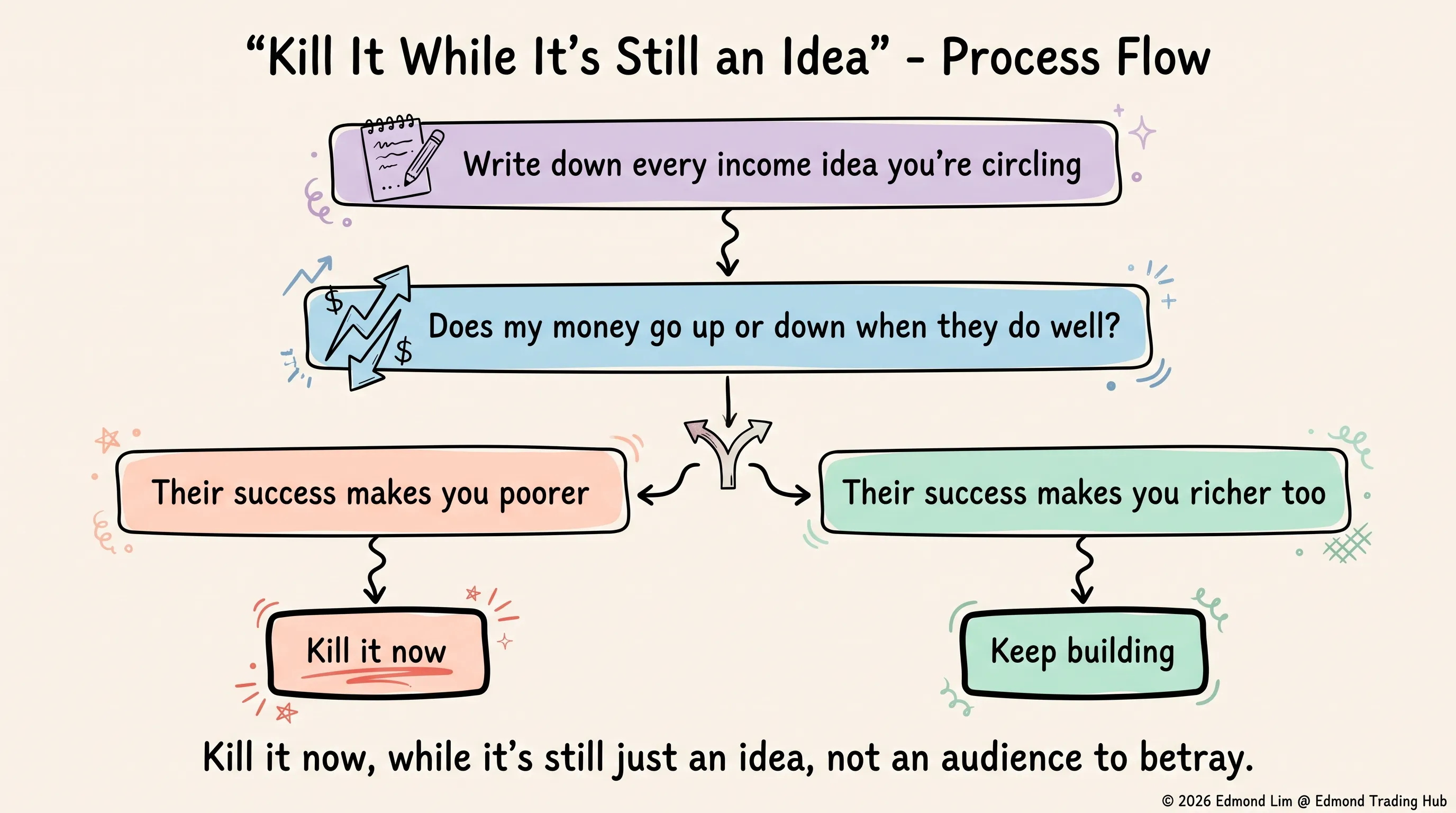
So do this today. Write down every income idea you’re currently circling in this space, and next to each one write whether your money goes up or down when the person on the other end does well. Anything where their success makes you poorer, kill it now, while it’s still just an idea and not an audience you’d have to betray to keep getting paid.
Free Weekly Market Outlook
Gold analysis, forex outlook and trading ideas — every Sunday.
Subscribe Free