If You're Just Starting Out In Trading, Here's What I'd Actually Tell You
Nobody blows up their account because they misread a chart, they blow up because of a deadline. What to sort out before you fund the account, what to measure in year one, and why the day job is the structure that makes trading possible, not a compromise.
⏱ 5 min read
Almost nobody blows up their account because they misread a chart. They blow up because they needed the money by a certain date. That deadline is the real opponent, and it does its damage quietly, by making you take the trade you would have skipped, size up after a loss, and hold something broken because closing it makes the number real. The chart reading is the easy part. Your timeline is what kills you.
So the first decision isn’t which strategy or which broker. It’s whether the money you’re about to fund the account with has any other job. If losing all of it would change how your month goes, if it’s supposed to also cover a car repair or your parents’ medical or next semester’s fees, then it isn’t risk capital, it’s someone else’s money that happens to be sitting in your account. Get the boring layer sorted first. A few months of expenses parked somewhere untouchable, high interest debt cleared, then whatever’s genuinely left over. That layer is not a delay to your trading, it’s the thing that lets you trade badly for a year without it ruining you, and you are going to trade badly for a year.
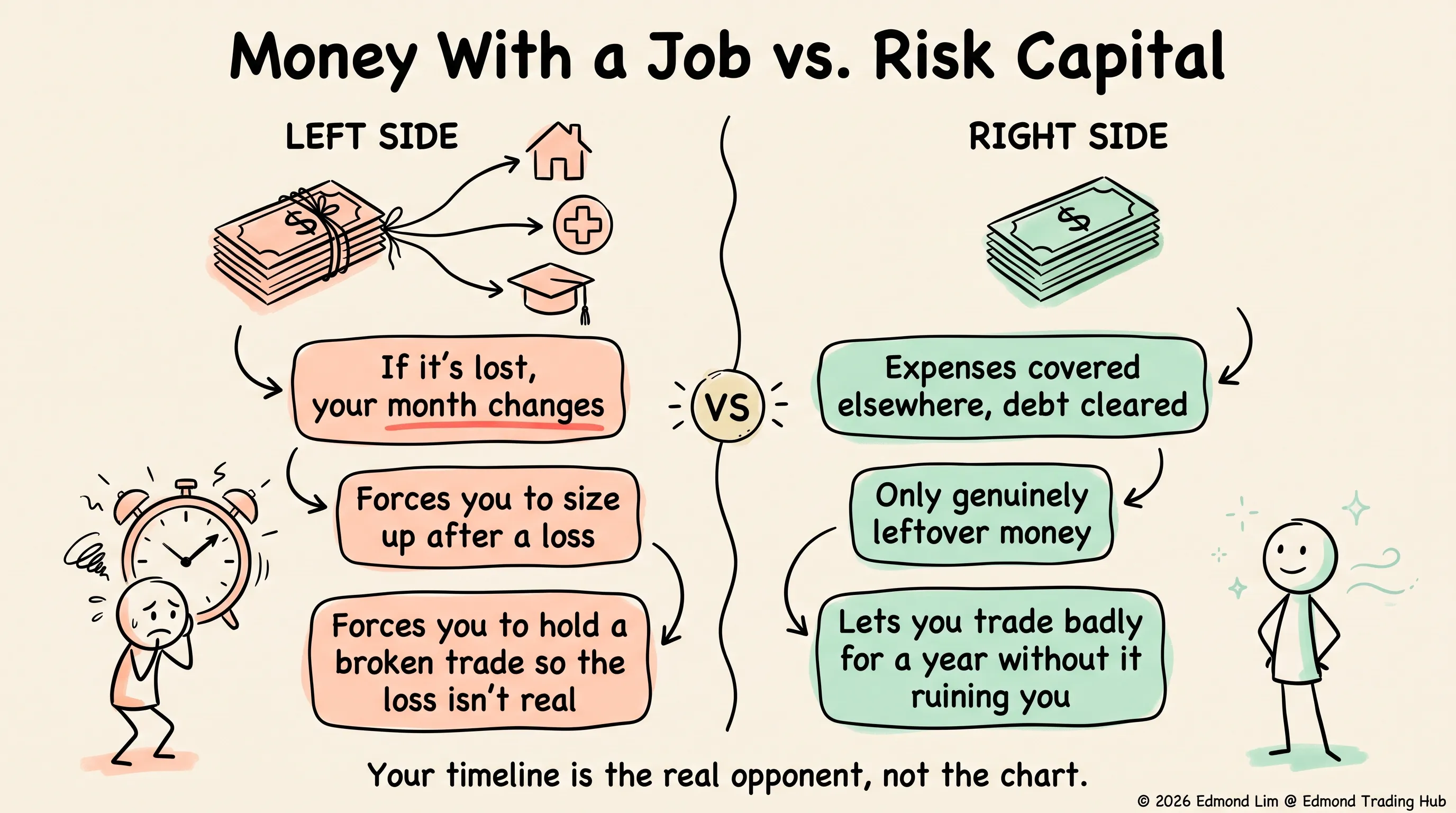
Which brings me to the day job. Keep it. I’ve been in engineering for over a decade and I trade around it, evenings and weekends, and I want to be clear that this isn’t a sad compromise I’m making until I’m good enough to quit. It’s the structure that makes the whole thing possible. An apprentice electrician doesn’t quit halfway through his training because he’s tired of being an apprentice. He gets paid while he’s still slow, and the pay is what buys him the years he needs to stop being slow. Your salary is doing exactly that. The moment your rent depends on this month’s trading result, every decision you make gets worse, and no amount of technical skill compensates for that pressure.
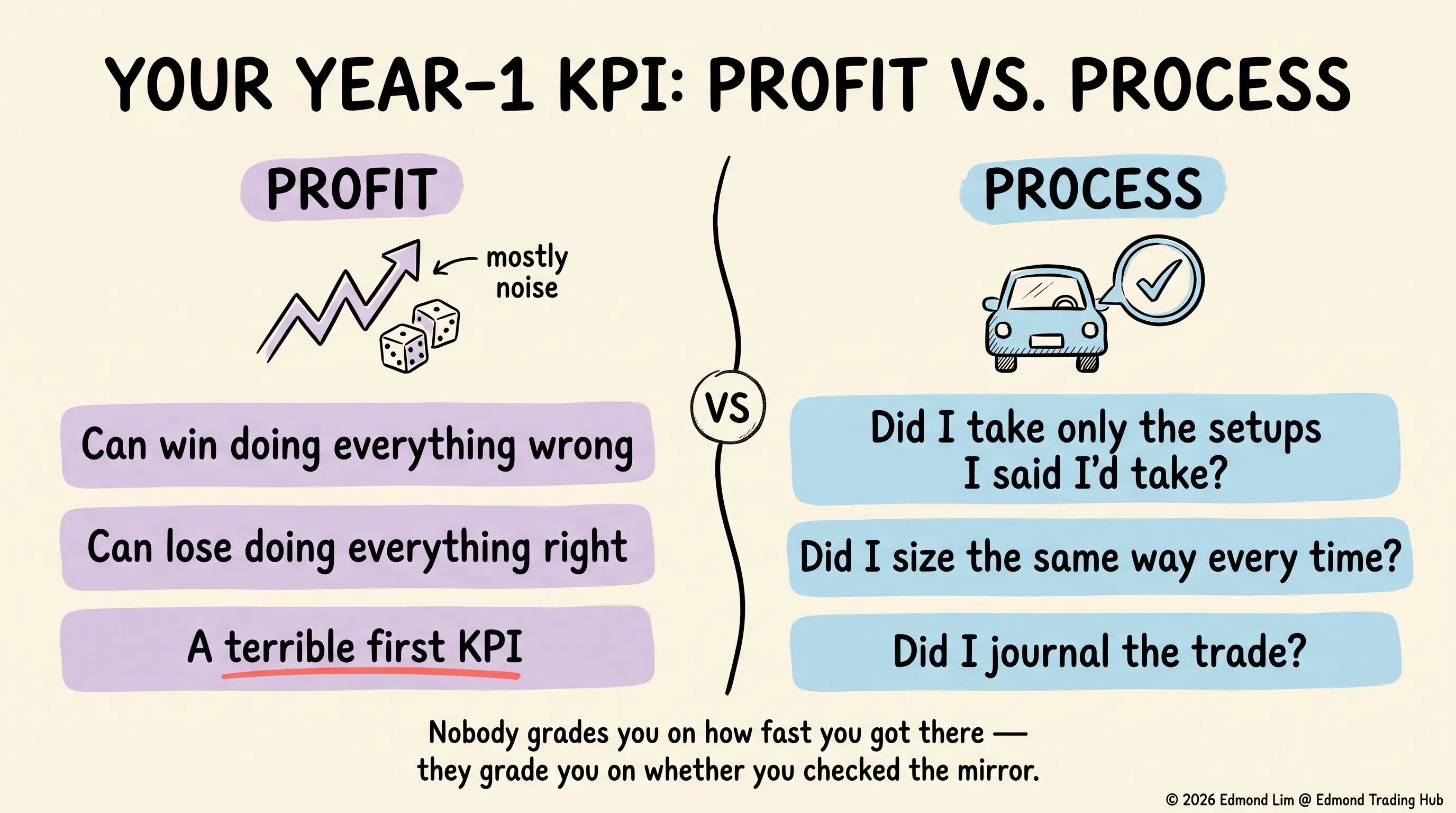
Then change what you’re measuring in year one. Profit is a terrible first KPI because it’s mostly noise at the start, you can make money doing everything wrong and lose money doing everything right. Measure instead: did I take only the setups I said I’d take, did I size the same way every time, how many trades have I actually journaled. When you learn to drive, nobody grades you on how fast you got there. They grade you on whether you checked the mirror. Same thing.
Narrow everything. One pair, one timeframe, one setup, for months. Beginners want breadth because breadth feels like learning, but breadth just means you never see the same situation twice, and you can’t build pattern recognition on a sample of one. A street stall that sells one plate of fried noodles ten thousand times ends up better than one that runs a twelve item menu, and it’s not close.
On demo accounts, use them, but understand their ceiling. Demo teaches you mechanics, where the buttons are, how a stop works, what a lot size does. It cannot teach you what happens in your chest when real money moves against you, and that reaction is most of the game. So go to live money earlier than feels comfortable, at a size that feels almost insultingly small. Risking fifty dollars for real will teach you more in a month than a demo account with a fake hundred thousand will teach you in a year.
Last thing, on paying for education. I’m not against it, but the timing matters. You cannot evaluate a teacher until you know enough to evaluate a teacher, and beginners are the group least equipped to tell a real track record from a good editor. Spend the first six months learning the basics on your own, free material is more than adequate for that. Then if you want to pay someone, you’ll at least be able to ask a sharp question and understand the answer. And always ask how the person gets paid if you never profit. It’s not an accusation, it’s just arithmetic.
I used to think the point was to get good fast so I could stop working. That’s a wrong mindset, and it’s the exact belief that makes people oversize and quit within two years. The point is to still be doing this in year five with a functioning account and five years of your own data, because that’s when a skill like this starts paying anything meaningful. Everything before that is tuition.
So, concretely, this week: work out the amount you can lose entirely without it changing your life, and cap the account at that. Pick one instrument and one setup and write the rules down. Open a live account with a size small enough that a loss is boring. Start a journal with one line per trade, what you saw, what you did, what happened. Give it a hundred trades before you allow yourself an opinion about whether you’re any good at this. Everything else, the indicators, the courses, the Discord groups, can wait.
Free Weekly Market Outlook
Gold analysis, forex outlook and trading ideas — every Sunday.
Subscribe Free